Final Degree Projects

Many of our members carry out their Final Degree Project (TFG) within the team, improving our robots and building new systems.

An essential part of the team

Where academic learning becomes real engineering

Final Degree Projects (TFG) are one of the backbones of STAR UMA. Many of our members choose to carry out their TFG within the team, channelling months of work into projects with a tangible impact: improving one of our robots, developing a new system or opening a research line that others will continue.

This model benefits everyone. The student takes on a genuine engineering challenge, with real hardware, real deadlines and problems that don't appear in textbooks; and the team gains advances that help our robots grow year after year. Each TFG leaves behind a lasting piece that the next generations build upon.

Below we gather some of these projects. Each TFG has its own space, with photos, videos and a summary of what has been achieved.

1
Final Degree Project

Control of a robotic arm
Salvador Patricio · Teleoperated manipulator for the HORU robot

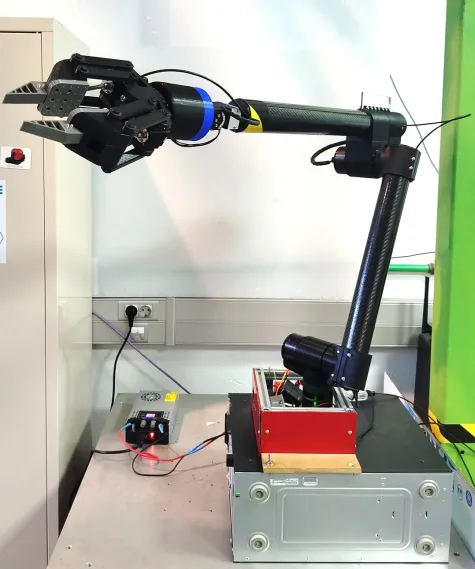
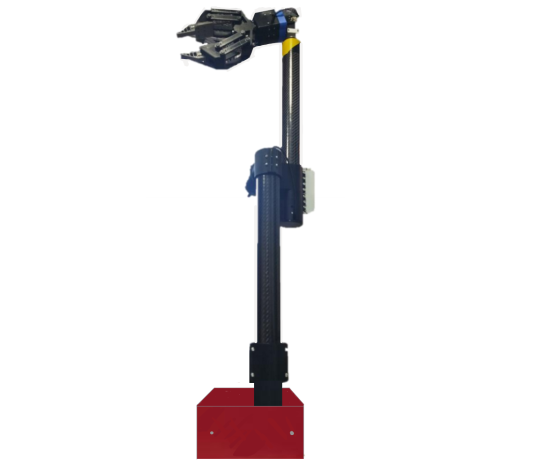
STAR UMA robotic manipulator arm Detail of the robotic manipulator arm

This TFG develops the velocity control of a robotic arm, enabling movement in Cartesian space through teleoperation. The operator specifies where and how fast the tip of the manipulator should move, and the system translates that command into the coordinated motion of every joint.

To achieve this, it implements velocity inverse kinematics algorithms that transform Cartesian commands into joint velocities. The result is intuitive control: the manipulator responds naturally to the operator's intentions, without having to reason joint by joint.

The ultimate goal is for this arm to be integrated with our HORU robot, giving it manipulation capabilities for rescue tasks: clearing obstacles, operating mechanisms or picking up objects in hostile environments.
Demonstration video

↑ Back to index

2
Final Degree Project

Improving the control software of a mobile robot based on ROS 2 and micro-ROS

María José López · Redesign of Donatello's control system

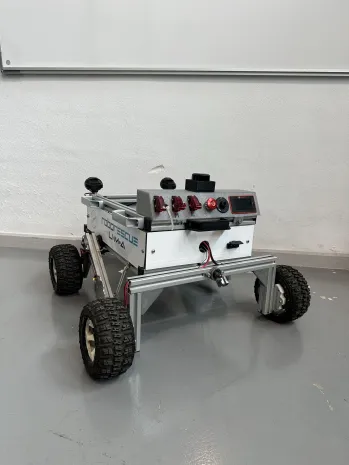
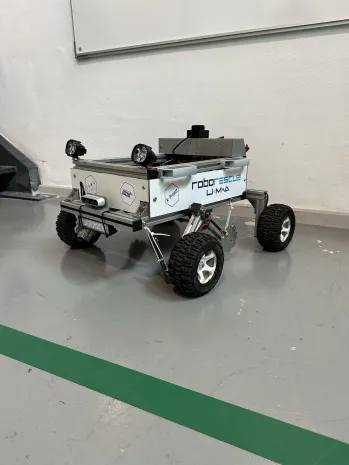
STAR UMA's Donatello mobile robot Side view of the Donatello mobile robot

This TFG tackles the redesign of Donatello's control software. The original system, implemented in Simulink, was not well suited for developing a robotic architecture, and its complex startup reduced the robot's availability. Using Linux and ROS 2 allows a modular, scalable structure that is consistent with today's robotics tools.

The transition to ROS 2 is accompanied by replacing the Arduino Mega 2560 board with an ESP32, capable of running concurrent tasks through FreeRTOS. On this hardware, a low-level control node is developed using micro-ROS, integrating the microcontroller as one more node within the ROS 2 environment.

This integration unifies the robot's architecture and guarantees the full operation of its operating modes: teleoperation, mapping and localization, and autonomous navigation.

Demonstration videos

↑ Back to index